
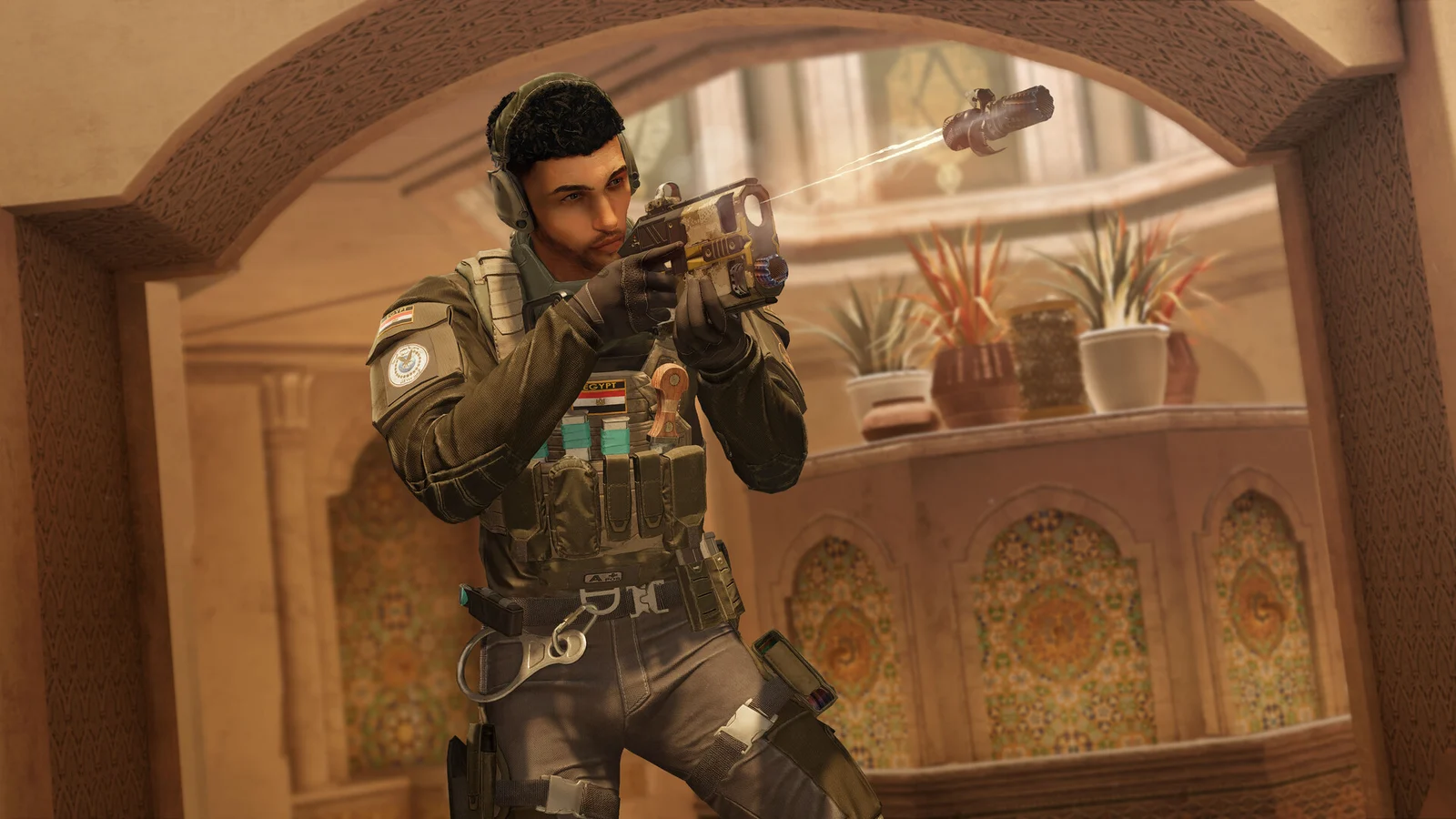
What the RCE-Ratero Charge is
Flores is an Attacker in the Ghosteyes squad whose specialties are anti-gadget play and intel. His unique ability is the RCE-Ratero Charge, a remotely driven charge that he steers toward a location while scouting a target area from afar. That framing is the core of the gadget: it is not thrown and instantly armed, and it is not a projectile you fire. It is driven, meaning the operator controls its movement toward the destination rather than committing it to a fixed arc at release. Because Flores's stated specialties are anti-gadget and intel, the charge sits naturally at the intersection of those two roles — it can be moved into a position to reach defender utility, and driving it means looking at the area it moves through. The source describes the capability but does not state a count of charges, a drive duration, a speed, or a control-scheme detail, so treat those as outside what is established here.
Driving it: steering toward a target while scouting
The driving phase is the part of the gadget that happens before any detonation. Per the source, Flores steers the charge toward a location while scouting a target area from afar — the movement and the information-gathering are described as happening together. Practically, that means the act of driving is also the act of looking ahead at where the charge is heading and what surrounds the destination. The source does not describe how the charge is steered, whether the view shifts, what happens if it is obstructed en route, or whether it can be recalled. Those are real questions a player will have, but they are not answered by the material here, so this guide does not fill them in. What is established is the sequence: the charge is remotely driven first, and the attach-and-detonate behavior comes when it is triggered.
Triggering it: attachment, armor, then explosion
The trigger step has three parts, and their order matters. When triggered, the RCE-Ratero Charge first attaches to the nearest surface. It then gains a bulletproof shell, and then it detonates. Reading the sequence literally is useful: attachment is targeted at the nearest surface rather than a surface of Flores's choosing, and the bulletproof shell is a property gained during the triggered sequence, after attachment. The source does not say how long any of these stages last, whether the shell can be destroyed, or whether the shell exists before attachment. It also does not say whether the charge detonates automatically once attached or requires a further action; the text describes a single trigger that leads to attach, armor, and explosion. Do not assume a delay window that the source has not stated.
What the explosion damages
The source states the explosion damages nearby gadgets and soft surfaces. That is the scope it gives: defender utility in the blast area and soft surfaces, which is consistent with Flores's anti-gadget specialty. The statement does not describe damage to operators, does not give a radius, does not quantify damage, and does not specify which gadgets or which surfaces qualify beyond the general categories. It also does not say whether damage falls off with distance or is uniform within the blast. If you are deciding whether to spend a charge on a particular piece of utility or a particular wall, the only supported claim is that nearby gadgets and soft surfaces are damaged — the rest is unverified and should not be treated as a mechanic.
Loadout context around the charge
The charge is Flores's unique ability regardless of loadout; the source lists his weapon and gadget options separately. As a primary he can take the AR33 assault rifle, the SR-25 marksman rifle, or the T-95 LSW light machine gun. His secondary is the GSh-18 handgun, and his gadget choice is either a Stun Grenade or a Claymore. This is a menu of stated options, not a recommendation — the source does not rate them or attach them to specific situations, and this guide will not invent a preferred pick. The relevant takeaway is simply that the RCE-Ratero Charge is not one of the selectable gadget slots; it is the operator's ability, so his two gadget options are separate from how the charge works.
Putting the sequence together
Assembled from the stated facts, the charge works in this order: Flores drives the RCE-Ratero Charge toward a location while scouting the target area from afar; when he triggers it, it attaches to the nearest surface; it gains a bulletproof shell; and then it detonates, damaging nearby gadgets and soft surfaces. Notice what the chain does and does not tell you. It tells you the mechanism is drive, then trigger, then attach, then armor, then explode, and it tells you the blast reaches gadgets and soft surfaces. It does not tell you how many charges exist, how far the charge can travel, how the driving is controlled, or how much damage the blast does. Those gaps are the honest boundary of this explainer; filling them would mean inventing details the source does not contain.
Questions and Answers
Does the RCE-Ratero Charge attach wherever I want it to?
No — the source says that when triggered, the charge attaches to the nearest surface. That phrasing points to proximity deciding the attachment point rather than a surface chosen by the player. The source does not say what counts as the nearest surface in a given situation or how the charge behaves if multiple surfaces are equally close, so those specifics are not established.
What does the RCE-Ratero Charge explosion actually damage?
Per the source, the explosion damages nearby gadgets and soft surfaces. It does not state damage to operators, a blast radius, damage values, or falloff, so those cannot be confirmed. The supported description is limited to nearby gadgets and soft surfaces, which lines up with Flores's stated anti-gadget specialty.
Is the RCE-Ratero Charge affected by my weapon or gadget choice?
The charge is Flores's unique ability, listed separately from his loadout options. The source lists the AR33, SR-25, and T-95 LSW as primary options, the GSh-18 as his secondary, and a Stun Grenade or Claymore as gadget choices. It does not state any interaction between those picks and how the charge works, so whether one loadout changes the charge is not established here.