

Turdlings: two bosses, one shared trigger
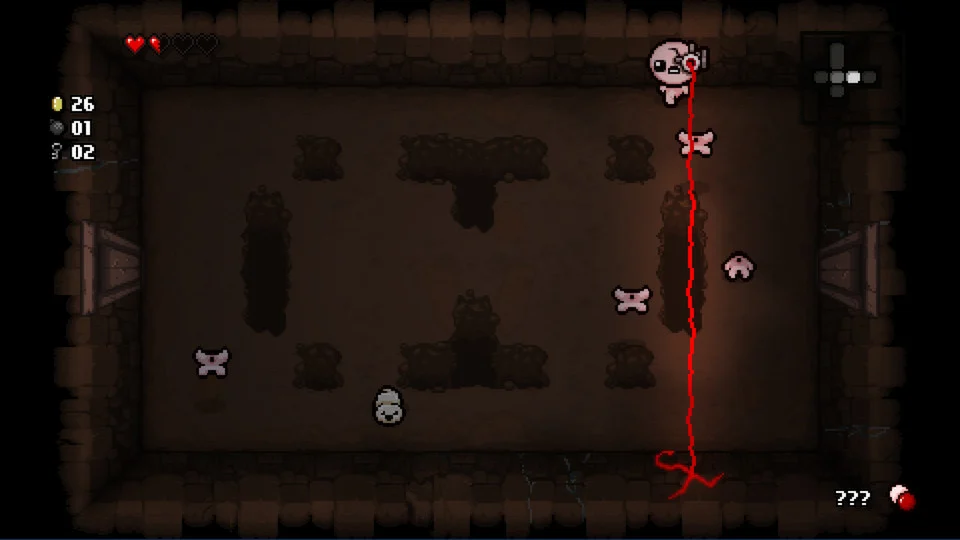
Turdlings spawn as a pair and wander around the room, and each individual Turdling performs its single attack independently of the other. That independence is the core read of this fight: there are two separate attackers with two separate decision cycles, not one coordinated pattern, so a break in alignment that stops one rush does not automatically stop the other.
Each individual Turdling has 50 HP, so the pair represents 100 HP of damage to clear, split however you choose to apply it. The attack triggers when a Turdling is aligned with Isaac in any cardinal direction; at that point it rushes at him and leaves slippery Brown Creep behind until it hits a wall. Two consequences follow directly from that wording. First, the trigger is alignment along a cardinal axis, not proximity and not a timer, so lateral positioning controls whether a rush can start. Second, the creep it leaves persists after the rush, so the room accumulates slippery surfaces over the course of the fight even if you dodge every charge cleanly.
Famine's first phase: the charge that exits the screen
Famine is a Harbinger boss found in Chapter 1 environments: Basement, Cellar, and — except in Rebirth — Burning Basement. That parenthetical is a placement condition, not a difficulty note: the source establishes where he can appear and that one of those environments depends on which version you are playing, and nothing further about how he behaves there.
In his first phase, Famine charges horizontally across the screen when Isaac is to his left or right, and the charge carries him off-screen so he returns from the opposite side. The important constraint is that leaving the screen does not end the attack — the charge is still in progress and he reenters from the other edge. He also summons Pooters up to a limit of two, and any Pooters caught in his charge are killed. The cap of two means the summon count cannot climb past that, and the charge simultaneously clears his own summons, so a charge can reduce the number of Pooters on screen rather than adding pressure.
Famine's phase change: the body and horse explode
After taking enough damage, Famine's body and horse explode and vanish, leaving only his head, which behaves like a Maw, moving slowly toward Isaac and occasionally stopping to fire three projectiles in a spread. This is a visible, physical change of state rather than a subtle texture swap: the horse and body are gone and what remains is a slow chaser with a periodic spread shot.
The transition is driven by damage dealt, not by a timer, so exactly when it happens depends on your damage output. The source describes the head phase as Maw-like behavior and gives the spread as three projectiles. It does not supply separate health values, movement speeds, or attack intervals for either phase, so those numbers should not be assumed here.
Dingle: stationary, with a whistle before the Dips
Dingle stays in place and attacks with three projectiles, a whistle that precedes summoning one to three Dips, and three fast bouncing dashes followed by a recovery pause. All three behaviors play out from a fixed position, so unlike Famine there is no off-screen travel to track and no second form described in the source.
The sequencing matters for reading the fight. The whistle is the cue that comes before the Dips are summoned, which makes it a warning rather than a reaction. The three bouncing dashes terminate in a recovery pause, explicitly identified as part of the pattern. Dingle's summon amount varies from one to three Dips, so the count is not fixed per whistle. Regarding placement, in Repentance and Repentance+ Dingle can appear in the Basement and the Burning Basement, whereas in earlier versions he appears only in the Basement.
The single confirmed item interaction in this set
Only one item interaction is given for these three bosses: Flush! kills Dingle immediately and leaves behind six Dips. Both halves of that outcome are specified — the kill is immediate, and the residue is exactly six Dips.
The evidence supplies no comparable instant-kill interaction for Turdlings or Famine, and does not state what Flush! does to either of them. The Dingle result should not be extended to the other two fights; the absence of a stated interaction is not evidence that none exists, only that the source does not establish one.
Uses & Related Dependencies 11
- Linked reading
- Linked reading
- Linked reading
- Linked reading
- Linked reading
- Linked reading
- Linked reading
- Linked reading
- Linked reading
- Linked reading
- Linked reading
Turdlings, Famine and Dingle: Reading the Pattern Changes in Basement Boss Fights
Connected Reading
Direct connections
 BossesDingleRelated reading
Turdlings, Famine and Dingle: Reading the Pattern Changes in Basement Boss Fights links to Dingle as related reading.
- BossesFamineRelated reading
Turdlings, Famine and Dingle: Reading the Pattern Changes in Basement Boss Fights links to Famine as related reading.
- BossesTurdlingsRelated reading
Turdlings, Famine and Dingle: Reading the Pattern Changes in Basement Boss Fights links to Turdlings as related reading.
 CharactersPlayable CharactersRelated reading
Turdlings, Famine and Dingle: Reading the Pattern Changes in Basement Boss Fights links to Playable Characters as related reading.
- Linked reading
Dangle: health, dash creep and Brownie Corn summons links to Turdlings, Famine and Dingle: Reading the Pattern Changes in Basement Boss Fights as related reading.
Dangle has 375 health (entity variant 261.1). He dashes twice in long bounces that leave slippery Brown Creep, fires three projectiles, and whistles before summoning one to three Brownie Corns. Some reported behaviours, like Corn Mine poison and Butt Bombs healing, are version-scoped.
- Linked reading
The Duke of Flies: health, movement and his orbital Flies links to Turdlings, Famine and Dingle: Reading the Pattern Changes in Basement Boss Fights as related reading.
The Duke of Flies has 110 health and drifts around the room in diagonal directions, with knockback able to redirect him. The source describes sending orbital Flies outward together with holding 5-6 of them, and a 4-Fly state where he can neither send them nor add more.
- Linked reading
The Duke of Flies: HP, Orbital Fly Limits, Champions and Floors links to Turdlings, Famine and Dingle: Reading the Pattern Changes in Basement Boss Fights as related reading.
The Duke of Flies has 110 HP (entity 67.0). He only launches his orbital Flies when he holds 5-6 of them, cannot add or launch once at 4, and stops spawning at 12 Flies total. Green and Orange champions each alter his spawns, and he appears on all Chapter 1 environments except Rebirth's Burning Basement.
- Linked reading
Gurdy vs Mama Gurdy: health, room position and the green champion form links to Turdlings, Famine and Dingle: Reading the Pattern Changes in Basement Boss Fights as related reading.
Gurdy has 595 health and stays fixed in the upper middle of the room; Mama Gurdy has 750 health and stays in the top wall. Gurdy's green champion form is 11% larger, skips projectiles and summons faster.
- Linked reading
Gurglings: Health by Version, Independent Pair Behaviour and Basement Floors links to Turdlings, Famine and Dingle: Reading the Pattern Changes in Basement Boss Fights as related reading.
Gurglings appear as a pair that wanders and attacks independently, with 90 HP each in Rebirth and 60 HP elsewhere. The Yellow champion brings three faster ones and no Creep or Attack Flies except in Rebirth, and they reach the Burning Basement only in Repentance and Repentance+.
- Linked reading
Larry Jr. Segment Splits, Turns, and Green vs Blue Champions links to Turdlings, Famine and Dingle: Reading the Pattern Changes in Basement Boss Fights as related reading.
Larry Jr. splits a segment only when the resulting piece would still be longer than two segments, and he re-turns whenever a segment dies or he bumps a Poop. Green champions fire a paused projectile; Blue champions are bigger, slower, share segment HP, leave no poop, and always drop a Soul Heart.
- Linked reading
Mega Fatty: Health, Off-Screen Jump, Fart Attack and Flooded Caves links to Turdlings, Famine and Dingle: Reading the Pattern Changes in Basement Boss Fights as related reading.
Mega Fatty has 600 health and entity ID 264.0. He jumps off-screen to land on Isaac's position and leaves a large Red Creep puddle, farts for close-range damage plus either 1-3 Dips or a projectile cluster, and appears in Flooded Caves only in Repentance and Repentance+.
- Linked reading
Pin: Burrow-Jump Attacks, Piercing Hits and Diagonal Shots links to Turdlings, Famine and Dingle: Reading the Pattern Changes in Basement Boss Fights as related reading.
Pin burrows before attacking and jumps out toward Isaac, then dives back down. Because each body segment is its own damage target, one piercing tear can register several hits, and in every version except Repentance/Repentance+ it sometimes fires four diagonal projectiles as it emerges or submerges.
- Linked reading
Rag Man: Health, Ragling Following and Which Chapter 1 Floors He Appears On links to Turdlings, Famine and Dingle: Reading the Pattern Changes in Basement Boss Fights as related reading.
Rag Man has 250 health in Rebirth and Afterbirth but 200 in other versions. While any Ragling is alive he stops chasing Isaac and follows one of them instead, and his floor pool is version-dependent: Cellar and Burning Basement only in Repentance and Repentance+, every Chapter 1 environment otherwise.
- Linked reading
Turdlings: HP, Wall-Rush Attacks, Brownie Corns and Floor Appearances links to Turdlings, Famine and Dingle: Reading the Pattern Changes in Basement Boss Fights as related reading.
Each Turdling in the pair has 50 HP. They rush Isaac when aligned on a cardinal axis, trailing Brown Creep until they hit a wall, then launch four Brownie Corns; sometimes they fart instead. Their floor pool is version-split between Basement-type and Catacombs/Womb Double Trouble encounters.
- Linked reading
Widow: Jump Distance, Landing Effects and Sack Limits links to Turdlings, Famine and Dingle: Reading the Pattern Changes in Basement Boss Fights as related reading.
Widow leaps roughly twice Monstro's distance, leaves White Creep and a Sack on landing, caps live Sacks at three, and can crush her own Spiders and Sacks.
Questions and Answers
What actually triggers a Turdling's rush?
Alignment with Isaac in any cardinal direction. When a Turdling is aligned that way it rushes at him and leaves slippery Brown Creep behind until it hits a wall. Because each Turdling in the pair attacks independently, one can rush while the other keeps wandering, so breaking alignment with one does not necessarily affect the other.
How can I tell that Famine has changed phase?
After taking enough damage, his body and horse explode and vanish, leaving only his head. The head then behaves like a Maw, moving slowly toward Isaac and occasionally stopping to fire three projectiles in a spread. The change is driven by damage dealt rather than a fixed timer, so the moment it happens depends on your damage output.
Does Famine ever leave the screen, and does that end his attack?
In his first phase he charges horizontally when Isaac is to his left or right, and the charge carries him off-screen so he returns from the opposite side. Leaving the screen does not end the attack; he reenters from the other edge. He also summons Pooters up to a limit of two, and Pooters caught in his charge are killed.
What warns me that Dingle is about to summon Dips?
A whistle precedes the summon, which brings one to three Dips. The whistle is a cue that comes before the Dips appear rather than a reaction to them, and the count is not fixed per whistle. Dingle's other behaviors are three projectiles and three fast bouncing dashes followed by a recovery pause, all from a stationary position.